
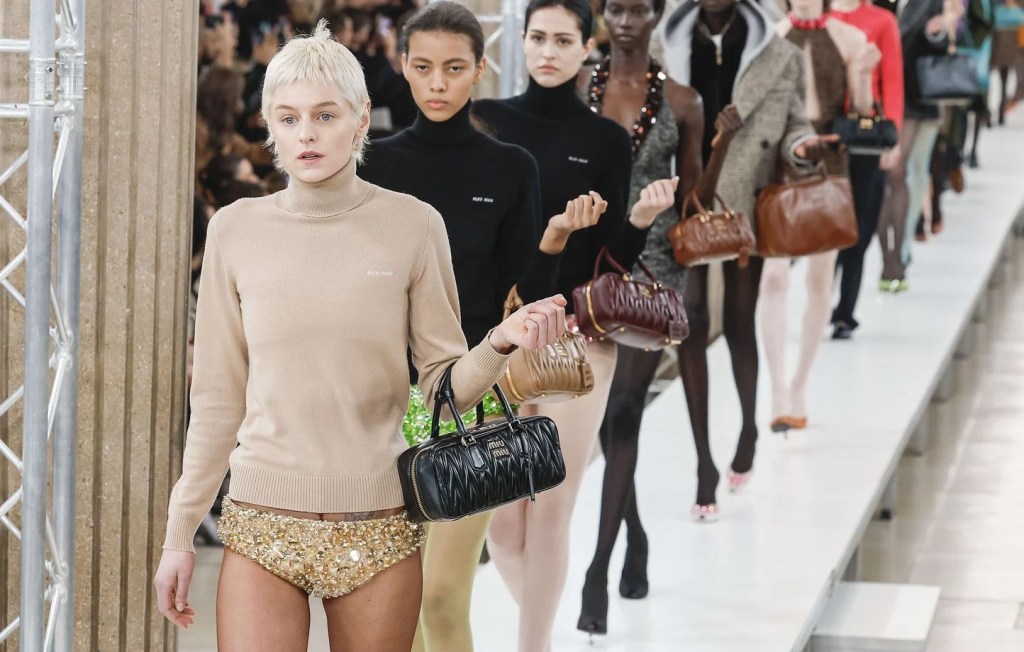
From glittery skin, tape wrapping the entire silhouette, transparency revealing the models’ naked bodies to pigeon-like handbags… these last few fashion weeks have been punctuated by a parade of mise en scene of all kinds — of clothing of all kinds.
When we see the ready-to-wear shows of certain brands, we wonder if the clothes are still wearable, if the fabric is still presentable, if fashion isn’t going too far… These are a whole range of questions that run through my mind and that I will explore in this article.
Listen to the symphony that plays around a show venue during fashion week. Listen to the honking horns, the insults, the ‘Get out of the way !’, the ‘But it’s so ugly!’, and the famous ‘What do you want ? It’s fashion.’ This street music is the voice of a fashion spirit that has become too cyclical. The desire to reinvent oneself by challenging the codes of what clothing is and what beauty is has become the norm, first in Haute Couture, then, through social media : in ready-to-wear — popular fashion. Between the dress over pants combo, and ripped clothes, how did « ugly » become trendy ?
The ketamine chic trend
Along with work overalls, women’s trousers, and anarchist punks, fashion has been a way to protest for decades. Between political protest and self-proclamation, anything can be trendy. In the 1980s, American supermodel Gia Carangi fell into the downward spiral of heroin addiction and died of AIDS. It didn’t take long for fashion to transform her tragic fate into a new trend : the heroin chic trend, with its androgynous, dark-circled, pale, and thin look, of which Kate Moss became the unwilling pioneer.
After a long campaign, things seemed to be looking better in the 2010s — especially with a major body positivity movement. But nearly a decade later, with TikTok’s rise as a trendsetter, the Y2K aesthetic is back, and heroin chic with it, under a new and healthier name : ketamine chic. Despite this new name, the unhealthy view of the body is still required. First adopted by teens and young adults having « cool » jobs such as DJ, model, or influencer, today, it’s celebrities who are taking over the style. Between buccal fat removal to hollow out cheeks and the consumption of Ozempic, fashion and the world of fame are taken by storm by this trend. This is both a consequence of the latest fashion shows, which maintain – despite TikTok – a certain power over clothing tendencies, but also, of a certain renewal of the trend system.
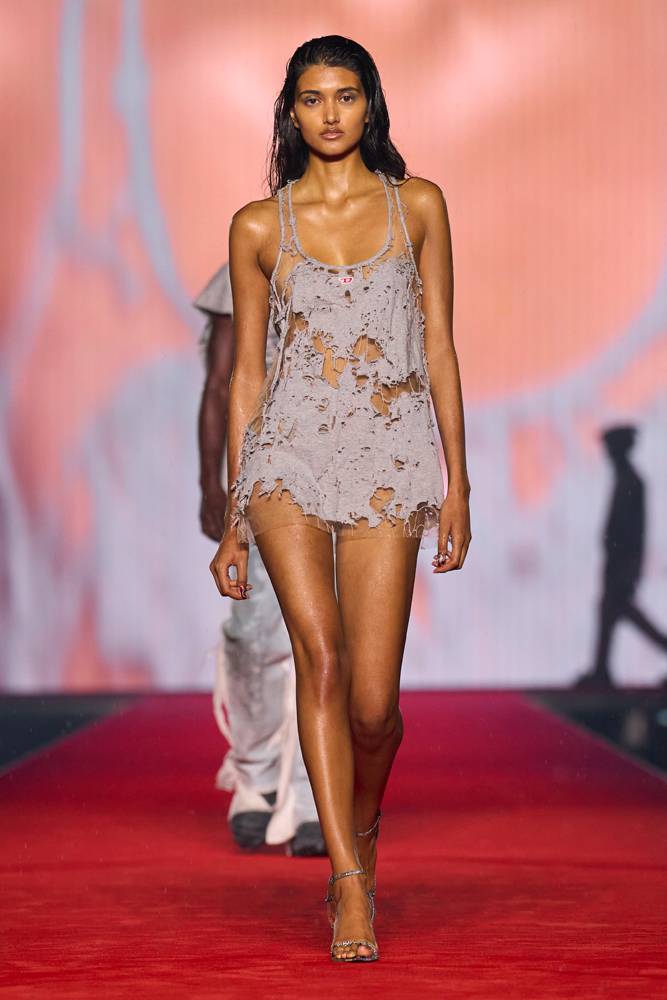
We’re currently wading through a pool of « micro-trends » that’s creating a great trend confusion in the fashion world. We end up mixing everything, resulting in a sort of fashion hybrid. We find ourselves in a festival of fabrics where the secretary in panties, the young man with satchels, and the girls in ripped, transparent, and glittery dresses parade in front of a mountain of condoms or on the stage of a rave party. It has a great success on the catwalks at Miu Miu and Diesel, but the weird nerd girl look and the distraught style of Glenn Martins’ latest collections are part of this large family of ketamine chic micro-trends. Although it can be seen as a middle finger to capitalist society and/or as a way to claim one’s identity and uniqueness, these young « Vivienne Westwoods » of the 2020s are only having reheating the 2000s style, health and social issues.
In times in which bodies’ representation is becoming necessary, this trend makes us take a big step back. More than that, this trend having the name of a drug shows that it continues to be a symbol of cool, and thus indicates the state of mind of the era in which we find ourselves : a disillusioned mentality, thirsting for fun and cynicism.
Is it ugly or is it camp ?
Ketamine chic is a trend that plays a balancing act between kitsch and good taste. This form of ugly in fashion reminds us of the camp aesthetic, which plays with exaggeration, grotesque, irony and provocation. Ugliness is proper to camp. Between the imaginary of beauty and the parody of bad taste, this aestheticism for non-beauty agrees in a line of very contemporary artistic schemes.
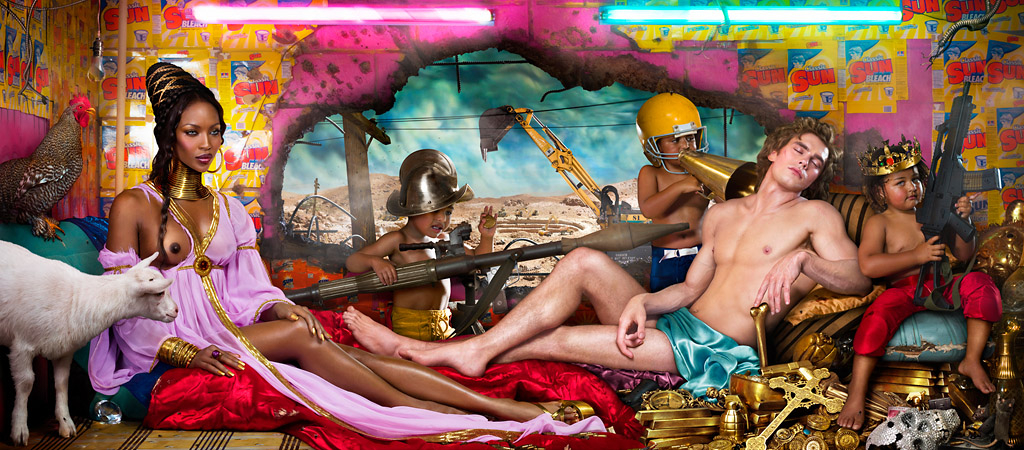
It is a stylistic movement born in the queer community between the end of the 19th and the beginning of the 20th century. Concept of a subculture, a certain « underground » culture, camp came out of the shadows in the 1960s thanks to a study by Susan Sontag : Notes on ‘Camp’. More than a way of seeing the world, it’s a way of living. With a desire to denounce and parody society, the beautiful and the just, it is a style that will get to the public eye in the 2000s. With the help of David LaChapelle, a famous artist and photographer who does not hesitate to undo and redo culture, and that of designers, such as Jeremy Scott (at Moschino in particular) or John Galliano who said: « Style is wearing an evening dress at McDonald’s, wearing heels to play football ». In 2019, the camp rises to the heart of the fashion world, being the theme of the fashion meeting of the year : the Met Gala.
The most difficult thing when you see the world through the prism of camp is to know how to get out of it. We have the impression that everything is camp ! And that’s camp ! See the humor, irony and exaggeration in everything. It is taking the mainstream and carnivalizing it in a denunciating form. It is an ugliness which provokes in fashion, and which opposes to conservatism, and a certain classical and legitimate culture, to make way for a certain form of spectacle and affirmation of self.
A reflection on youth
With collections such as those of Barragán, Mowalola or Avavav, designers show us the new era of fashion, and the real function of ‘ugliness’. Its effect on the public can be compared to those caused by the punk movement in the 1970s, integrated into fashion in particular by Vivienne Westwood.
Barragán and Mowalola do not only give the finger to capitalist society, they turn into collections major societal problems such as poverty, the environment, exploitation and the many geopolitical conflicts. Avavav plays more on a note of irony and spectacle similar to the camp aesthetic and creates runways where chaos and performance are mixed in order to denounce the issues of our society as in its runway : « No Time to Design, No Time to Explain », which reveals precisely the tendency of having « express trends » that overturn the entire traditional fashion system.
Even though, today, singularity is no longer as problematic as before, the stylistic and aesthetic innovation in which we find ourselves allows everyone to find their own identity and to affirm an appearance that engages in a liberation action. This denunciation mentality is the reflection of the state of mind of those who wear this ugliness, and demonstrates the importance of fashion in expressing the rebellion of young people against a capitalism increasingly eager for novelties.
Conversation with Marie Gaguech
Marie Gaguech is a content creator on social media. After studying at ESMOD Paris, she started as an assistant shopping stylist at Grazia, where she met Garlone Jadoul, Angèle‘s former stylist, who took her under his wing. She then worked for a year on Angèle’s tour, then with DJ Snake, as a fashion assistant. She continued to work with Garlone on campaigns with L’Oréal, Lancôme, until the pandemic, which put all her projects on hold. She then came up with the idea of starting to post content on social media. She doubts, but after a long reflection and a breast reduction, she takes the plunge and starts on Youtube where she finds a community on second hand and luxury. Passionate about these two themes, she will continue on Tiktok. Eiffel Tower bags, red hair, Miu Miu style, and shiba inu, Marie Gaguech goes viral.
Today, Marie, at the heart of the explosion of micro-trends on the social media, talks with me about the place of fashion in her life and in society, the last shows, and the future of fashion !
WHICH PLACE HAS FASHION IN YOUR LIFE ?
« I think fashion has always had a very big place in my life compared to other children who may not pay attention to it. For me, it wasn’t too much a question of money, but my parents were not the type to invest in clothes, especially my father. My ‘taste’ in stylism arrived quite quickly. In primary school, I already put on berets, I was the girl who always adds her accessory. It followed me til high school, and it really ended up being part of my identity. I have always felt ‘safe’ with clothes. You don’t need to talk, they express themselves.”
HOW WOULD YOU DESCRIBE YOUR STYLE ?
« This is a question that I am asked all the time and I have a lot of trouble answering it ! I have no words to describe it… I would say ‘discovery’, ‘vintage’ – even if it’s not the subject I talk about the most now, it’s all the time on me, I’m passionate about what belonged, there’s history. I wear my clothes a lot, I don’t protect them, it’s really my second skin ! When I buy a luxury piece, the goal is not to protect it at all costs, it doesn’t matter if there are elements that come off. I’m often told ‘But your boots are fucked !’ And I answer ‘Yeah ! I’ve put them 15 times !’. I am someone who walks a lot, who takes the subway a lot. My style is really second skin, according to my mood, if I’m going to work, depending on the activity, it will vary. »
WHAT DO YOU THINK OF THE LAST SHOWS [Miu Miu and Diesel especially] AND WHAT DO THEY BRING ?
« Already, we are moving away from maximalism. We are at a turning point noted by the departure of Alessandro Michele from Gucci, the highly anticipated return of Phoebe Philo to Céline, or The Row highlighted by Kendall Jenner. Fashion remains a cycle. Our eye has seen something so much, that afterwards, it tells you ‘I can’t take it anymore’ – it’s like food, we eat so much the same food, that you want to discover other flavours. We arrive at a more refined form, and so you discover the aesthetics around it like office wear, and what could be more refined than work clothes ! I don’t think we are witnessing the arrival of ugliness, we are moving away from the criteria that society has imposed on us for years, and the goal of fashion is to let people express themselves, this is increasingly the case. We want other representations of bodies, skin colours, everything we can see on the street, and that’s what’s beautiful ! We are not in the ‘representation of ugliness’, I think we are just in the ‘non-representation of glamour‘ that there is around fashion : the hyper-pulled brushing, the ‘perfection’ of the woman. We are moving away from it little by little. Women work a lot, they don’t apologise for being in skirts and stiletto heels all day ; we just get to a balance. »
FOR YOU, WHAT IS THE FUTURE OF FASHION ?
« The other day I was tagged on a post about the trends that are coming back and I found it super interesting. We always say ‘trends are coming back !’, yes, but they always come back a little changed. I don’t think we’re going to get out of this cycle, because like everything, you go back to what you know, because that’s what’s reassuring. During our childhood, we grew up with codes, and unconsciously, we will always return. Often, when we ask ‘who is your fashion icon ?’, people often bring out the names of parents, big sisters, etc. I admired my mother, and right now it’s my niece who admires my style. I think that, from generation to generation, it will never stop. It’s just that right now, we are in a cycle of ‘micro-trends’ – thanks to and because of Tiktok. The app has really made a ‘boom’ for fashion that I find super interesting, especially with luxury on social networks. Today, it has become super important for brands to position themselves at this level, a few years ago, it was much less the case, it was much more in the press. I think it’s also important to notice the place that social networks have taken, and step by step, to see these trends that die extremely quickly – the leopard is timeless of course, right now it’s back in fashion, but in two months it’s over, the red tights, it’s already dying a little too… I think that at some point, we’ll leave that and we’ll go back to aesthetics that last a little longer, maybe with the arrival of a new app, the return of Tumblr, or something like that. »
 OUTERNET MAGAZINE
Laisser un commentaire