
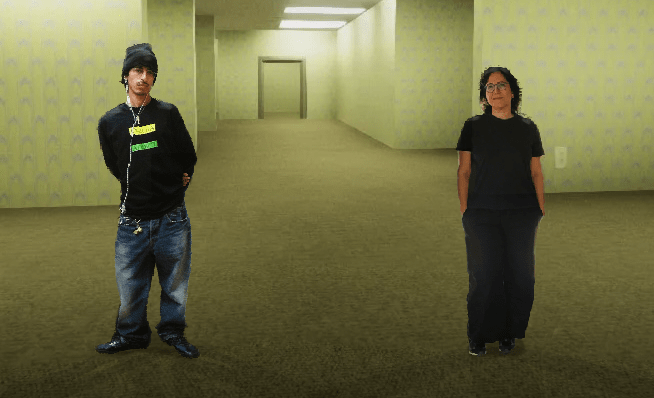
In the era of a saturated Internet, where the border between real and virtual seems to fray a little more each day, two singular voices help map the tremors reshaping our digital and artistic practices. Imranepresents, both artist and online entity, joins Valentina Tanni, critic and theorist of digital culture, to trace the contours of lore, corecore, hauntology and nostalgia. Together, they probe the new sensibilities emerging from a world where memory loops, images mutate, and culture haunts itself.
Imranepresents is a contemporary artist whose primary medium is the Internet itself. Through POV, his merchandising brand drawing on online and contemporary culture — references, memes, video games — he forges new bridges with today’s pop imaginary. A recent yet fervent devotes of ASMR, he approches the format as a field for experimentation, moving between irony and politics. Imrane drifts between content creation and artistic performance, probing our relationship to the digital trace, the gaze and the endless currents of the online world.
Valentina Tanni is an Italian critic and theorist of digital culture, author of Exit Reality. She specialises in analysing online practices and the aesthetics that emerge from them. Her work gravitates toward the rising phenomena of the Internet — from corecore to lore, via hauntology and nostalgia — examining how these forms reshape our relationship to art, the virtual and the collective. Through her writing and public interventions, she decodes the cultural dynamics structuring our digital imaginaries and shed light on the new sensibilities taking shape in an age saturated with information.
RECENTLY, IN ONE OF YOUR POSTS, YOU TALKED ABOUT YOUR DESIRE TO ABANDON THE ‟FANTASY OF A CLEAN AND RESPECTFUL DIGITAL TRACE”. IS IT A FORM OF RESISTANCE, OR SIMPLY THE CONSEQUENCE OF A DIGITAL SATURATION ?
IMRANEPRESENTS : The context of the post was mainly to tell people who follow me on Instagram that I also do ASMR — knowing that my Instagram audience is not the same as that of TikTok or Twitter. For me, Instagram, now, gives LinkedIn vibes. It was almost like a coming out.
I wanted to say that having a digital trace that is not cringe, but clean and controlled, is a huge privilege. When you have to create your own path in the very closed environment of contemporary culture and art — especially in Paris — , you must put yourself in the spotlight, and therefore go through so-called ‟cringe” moments.
It was also a way of saying that I abandon the fantasy of becoming the ‟cool kid” artist, bourgeois, with 300 followers, discreet… but very respected. No : if I want it to work for me, I need to assume that I am sometimes cringe in public.
CREATE YOUR OWN LORE IN THE END… VALENTINA, WHAT DOES THIS WORD MEAN IN OUR CULTURE ?
VALENTINA TANNI : Lore connects people, ideas and events. It is a collective way of navigating the intrinsically chaotic nature of the Internet and coping with life in a world flooded with information.
At the same time, lore is the clearest expression of the enormous influence gaming culture has on the minds of young people. It reveals how deeply the ‟gamer mindset” has been internalised : players are both producers and consumers of stories and mythologies. From this point of view, lore is a form of contemporary myth-making.
IT ECHOES THE CORECORE AESTHETIC… HOW WOULD YOU DEFINE IT ?
IMRANEPRESENTS : For me, corecore is simply a new human way of categorising and sorting this immense galaxy that is the Internet : images, gestures, vocabularies, rituals, languages… It is the most human expression that has found its place online.
VALENTINA TANNI : I would say that corecore is the logical end point of Internet aesthetics. The moment when the notion of core folds into itself and reveals its true nature. In reality, the suffix carries more meaning than the prefix : the prefix can be swapped out endlessly, anything can become a something-core.
The suffix, on the other hand, indicates the underlying sentiment, the real intention : to reach the heart of things, their primal energy ; but also core as obsession, repetition, and exaggeration. Corecore is ultimately the most radical celebration of our feelings.
IS THERE STILL A HIERARCHY BETWEEN ‟ART” AND ‟CONTENT” ?
VALENTINA TANNI : The concept of art has never been universal nor stable : it always implies a value judgement, which varies according to eras, communities or cultural systems. We therefore have no infallible criteria to distinguish ‟art” from the rest. Today, everything can become ‟content”, even the most famous art piece in the world. If there is a difference, it is not in the form, but in the intention — and, of course, in the eye of the beholder.
IMRANEPRESENTS : For me, these two words do not really belong to the same lexicon. What I post is both content and art. Technically, it’s content because it’s watched on a phone, via a so-called ‟social” media platform, but it’s also art because I have no control over how people will perceive it.
YOU’RE AWARE OF THE PERCEPTION OF YOUR POSTS…
IMRANEPRESENTS : There is an awareness, yes. What interests me is to have an artistic approach. I am more inspired by performance artists than content creators to build my posts. I am thinking in particular of the work of Amalia Ulman, one of the first to perform on Instagram — a real slap in the face when I discovered her.
But my greatest inspiration remains my TikTok For You Page. It is also a form of channelling the flow : a pause, a step back to wonder what we are seeing, and what is at stake there and what is possible.

IN YOUR BOOK, YOU MOBILISE THE NOTION OF HAUNTOLOGY — THIS NOSTALGIA FOR FUTURES THAT HAVE NOT TAKEN PLACE. IN YOUR OPINION, WHAT FUTURES HAUNT US TODAY?
VALENTINA TANNI : We are haunted by unfulfilled promises : utopian visions of futures that never came to be, promises of prosperity or technologies that are supposed to improve society. And then there are these inventions that we were taught to imagine, but which never really saw the light of day — teleportation, time travel… They are ghosts of possible futures, always in the background.
THE INTERNET HAS BECOME A BIT OF A HAUNTED SPACE…
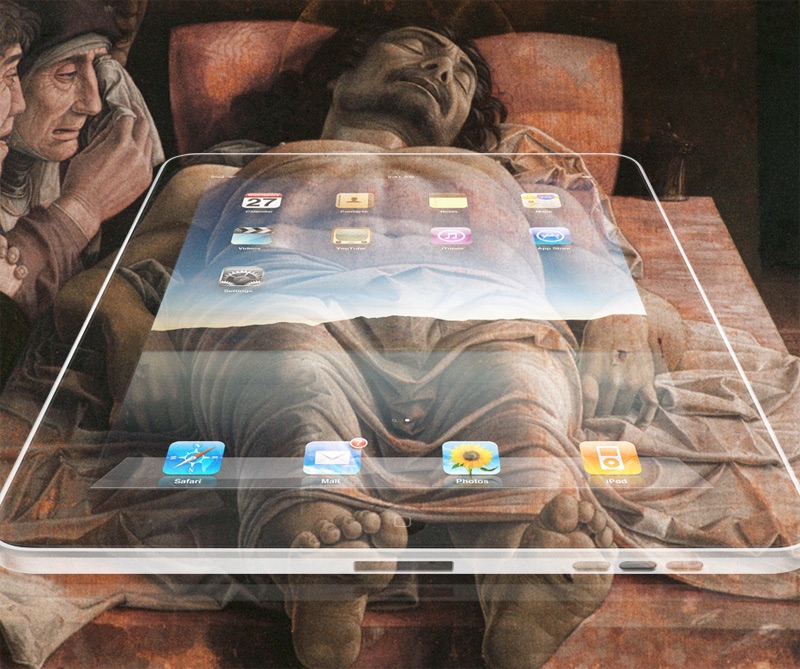
VALENTINA TANNI : The Internet is indeed a haunted space — and has always been. It is a huge container where we pour billions of stories, images, desires and fears : a marvellous and terrifying archive of the collective unconscious.
IMRANEPRESENTS : I have the impression that it has become a circular labyrinth : we start from a point, we make a complete turn, then we return to the same place — and we start again. The Internet works like an infinite cycle, a little haunted. Just yesterday, I told myself that I should delete everything I posted on TikTok, that deleting had to be part of the process.
We should be able to post and then make things disappear. We’ve become too accustomed to everything existing forever. That’s why I like Instagram stories : they disappear after twenty-four hours. It would prevent the Internet from becoming a cemetery of traces. Digital is destroying our natural relationship to memory — which is beautiful when it remains abstract.
WHEN WE SCROLL TODAY, WE INTERACT WITH HUMANS OR WITH HUMAN GHOSTS ?
VALENTINA TANNI : With humans, ghosts, machines and all sorts of hybrid creatures.
IMRANEPRESENTS : And that’s exactly what’s interesting. It highlights networks like Discord : people need community, to feel that they are talking to real humans. We perceive, more than ever, this desire for humanity. For me, it’s not tragic to talk to robots — I just think it will pass, that in a year, Grok, for example, will disappear.
VALENTINA, YOU WRITE ‟ASMR VIDEOS ARE NOT CONTENT TO BE UNDERSTOOD, BUT IMPULSES TO TRANSMIT AND RECEIVE”. WOULD DIGITAL BECOME A NEW FORM OF TACTILE COMMUNICATION ?
VALENTINA TANNI : I would not use the word ‟tactile”, because touch — like smell — is unfortunately still left out. But precisely because some senses are blocked, people are inventing new ways to stimulate them from a distance. To simulate a more advanced form of remote connection than the one we have. ASMR is one of these tactics.
YOU IMRANE, YOU SAY ‟IT’S NOT A QUESTION OF FICTION, I WRITE ABOUT WHAT I LIVE, WHAT I THINK I SEE”. CAN WE STILL DISTINGUISH TODAY WHAT WE LIVE AND WHAT WE POST ?
IMRANEPRESENTS : This sentence came from a series of writings that I had made for a radio. I wanted to say that if what I say is not ‟true”, it is not intentional : these are things that I see or think I see. It’s a kind of guideline for all my work. I start from what I live and what I think I perceive. With ASMR videos, I like to create these speculative realities, a kind of space that is both real and fictional, real and virtual — but still real.
HAS LIMINALITY — THESE SPACES BETWEEN TWO, BETWEEN REAL AND VIRTUAL — BECOME A BIT OF OUR AESTHETIC CONDITION ?
VALENTINA TANNI : We cannot reduce our aesthetic condition to a single trend. If anything defines artistic expression today is diversity : a multitude of styles, sensitivities, modes of expression that coexist and influence each other. That said, liminality is definitely a key concept to understand contemporary sensibilities.
HAS NOSTALGIA, PARADOXICALLY, BECOME OUR LAST COLLECTIVE LANGUAGE ?
IMRANEPRESENTS : I hope not. It’s a dangerous concept, almost a drug. For me, it’s crack : I try to avoid it, not to relapse. When I hear the opening music of Animal Crossing on Nintendo DS, yes, I want to cry. We can create a collective with a lot of new things, but we love looking back. It’s a hyper addictive emotion. We are lazy : we prefer to turn around rather than move forward. And being depressed with others is always more reassuring than being sad alone.
VALENTINA TANNI : I think nostalgia is a very widespread emotion, but I feel like we are approaching a breaking point. This thick, layered, almost atmospheric nostalgia seems ready to mutate. Maybe just because it has become too dense for us to still bear. You can sense some kind of reaction starting to brew.

Between haunted archives, addictive nostalgia and speculative realities, a distinctly contemporary aesthetic condition is taking shape : one in which humanity drifts between the immediacy of the digital flow and a renewed hunger for meaning. The virtual is no longer a mere space of representation, it has become a terrain of lived experience, emotion and emerging mythologies. Every fragment, every residue — whether it vanishes in the stream or persists — folds into the way we sense, narrate and imagine the world today.
 OUTERNET MAGAZINE
Laisser un commentaire