
Still in its infancy but rapidly gaining momentum, Le Paris Noir, founded in 2025, is expanding on an unprecedented scale under the leadership of Paloma Dubois, the first Guadeloupean student to be admitted to Yale University. Following the success of its inaugural edition at Point Ephémère, the project moved to La Rotonde Stalingrad for its second edition, held from 24 to 29 May 2026. With a larger team, new artists and an expanded exhibition programme, Le Paris Noir is steadily establishing itself as a significant new player in Paris’ cultural landscape. Yet growth brings its own challenges : how do you reach a broader audience while remaining accessible, coherent and unapologetically political, without diluting the festival’s message or slipping into amateurism ?
Des workshops to community : the challenge of passing knowledge forward
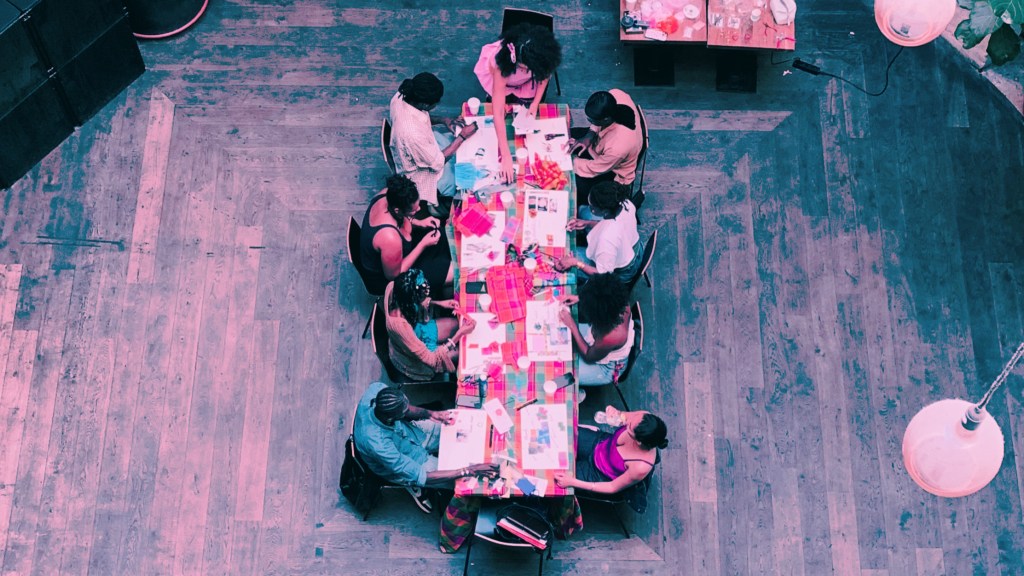
If building a community means sharing and creating together, Paris Noir is rooted in the direct transmission of skills and knowledge, a common thread weaving new connections. On Tuesday, May 26, workshops gradually came to life at La Rotonde, where Carmen Joachim shared her expertise as a seamstress during a session attended by around ten participants. Drawn by a desire to learn textile craftsmanship, attendees left with creations of their own : hair clips, keychains, personalised posters, and other accessories adorned with elegant madras bows. A self-taught designer, Carmen learned the craft in her bedroom, « with YouTube tutorials and a slightly broken sewing machine ». Despite the demands of her studies, she says she never stopped pursuing her ambitions in fashion and design, beginning to work with madras fabric three years ago. For her, the choice came naturally : « This fabric is like a comfort blanket that I carry with me ». « When my grandmother passed away, it felt like a part of her was missing from my life. That’s when I started using these fabrics. Over time, I began wearing my own creations, but I’ve also designed pieces on commission for artists such as Carla Genus and Bamby ». For the designer, the combination of the bow motif and madras fabric reflects a desire to create a dialogue between tradition and modernity. « I love pairing a girly, modern, Parisian shape with madras, which is deeply traditional. Right now, I think there’s a real need to reconnect with our roots, and you can see that reflected in people ». By joining the Paris Noir project, Carmen emphasises the significance of the collaboration itself. « This partnership means a lot to me. People have often encouraged me to launch a brand, but I’m not really interested in the branding side of things. What I value are these moments with people, the transmission of knowledge and a relationship to clothing that feels much more genuine and grounded ». According to her, she and Paris Noir are a « perfect match ». « Even though we’re in Paris, we’re still children of the diaspora. I think it’s important to stay connected to our roots and to those who came before us ».
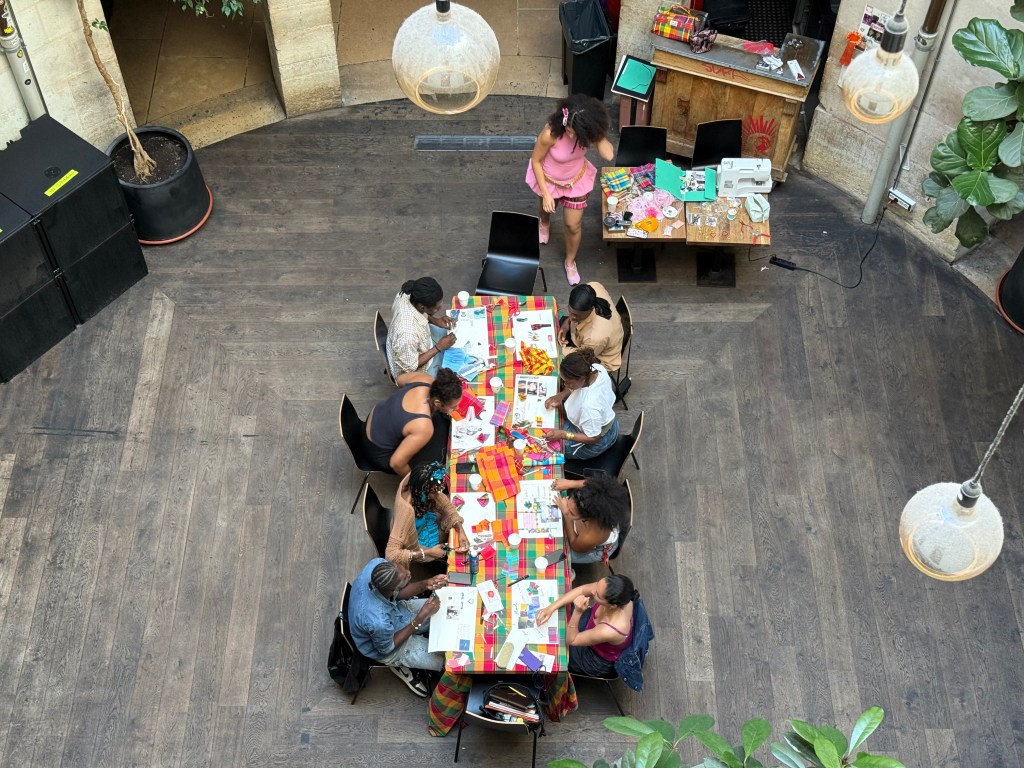
In the atrium, creative techniques intertwine. Collage, cutting, and weaving coexist beneath posters and slogans plastered across the walls: provocadora, louder, dreamlike. At Carmen’s table, where participants gather to seek advice, conversations flow freely. Beads, pins, fabrics, and ruffles pile up in a joyful mess, revealing the richness of a tradition constantly being reimagined. Yet the following day, Wednesday, May 27, the energy of the previous evening gives way to an unexpected silence. No workshops, talks, or DJ sets are scheduled during the festival’s only day dedicated exclusively to the exhibition. Given the project’s strong ties to Guadeloupe, the absence of any special programming on such a symbolic date, the commemoration of the abolition of slavery in Guadeloupe, feels like a missed opportunity. Anthony, who came to discover the festival, describes his experience positively thanks to a chance encounter with artist Laurent Yaho, who took the time to walk him through his work. Still, he found himself questioning the exhibition’s minimalist scenography. Faced with the artworks, visitors occasionally struggle to find their bearings. While the simplicity of the wall labels does encourage conversation and direct engagement with the artists, Anthony regrets an experience that is less autonomous than it could have been. In his view, adding « just three lines » of contextual information or simple QR codes linking to the artists’ social media pages would have enriched the visit. Ultimately, the exhibition itself sometimes feels secondary, overshadowed by the festival’s other highlights. For an event that places dialogue at the centre of its philosophy, more opportunities to engage with exhibiting artists, through roundtables or guided discussions, could have amplified the impact of these encounters. One thing becomes clear : whenever meaningful exchanges emerge between artists and audiences, the magic happens almost instantly.
That spark was fully evident a day later during a workshop led by designer Yam’s. A resounding success, the session won over participants across the board. It is precisely in these moments of collective exchange, where conversation flows freely and organically, that Paris Noir reveals its most essential purpose : a space for dialogue where culture is not merely observed, but lived and built together. Inside the Mini-Club room, a sneaker-design workshop unfolds to the sound of « On A Changé », the signature track by Les Déesses. Around the table, participants busily cut, colour, and assemble the templates of the iconic Air Force 1, piece by piece. Among the concentrated faces is cultural journalist Luc-Roland Kouassi, visibly enjoying the experience. Drawn in by the name of a festival that, in his words, « feeds the imagination », he immersed himself in both the madras workshop and the sneaker-design session. Beyond the simple pleasure of reconnecting with hands-on creative work, he expresses both surprise and admiration for the journeys of the workshop leaders, noting how rare it remains to encounter racialised designers working at this level. « What resonates with me is a sense of pride. There are people from the Black community who are trying to break through the glass ceilings we once imposed on ourselves. Seeing people dare to do it, and seeing that it’s possible, is already important for our representation ». Luc-Roland emphasises the importance of visible role models, arguing that without them, self-censorship often prevails. By showcasing artworks that celebrate art « in all its forms » and are created by artists from diverse backgrounds, the exhibition becomes a catalyst for inspiration. « When we see examples of people who succeed and who look like us, it creates vocations. It shows that we can succeed, that we can create meaningful work, that we can embrace our differences while still moving forward together ». As the workshop draws to a close after more than two hours, Yam’s introduces us to his artistic journey. A designer for Nike, founder of the brand Bandozi, and a child of the 2000s, his love affair with design nevertheless began on the streets. « I started out doing graffiti. Whenever I had paint left over, I’d customise my sneakers. Little by little, I began taking pairs apart, rebuilding them, and eventually I thought : why not approach factories and start producing my own designs ? That’s how the brand was born ». Invited by the festival, he conceived the workshop as an accessible moment of transmission and discovery. « The idea was really to provide a broad introduction to shoe design : what goes into it, how it works, the whole process ». Despite the limited time available, the challenge proved successful, with most participants leaving the workshop with a finished product in hand.
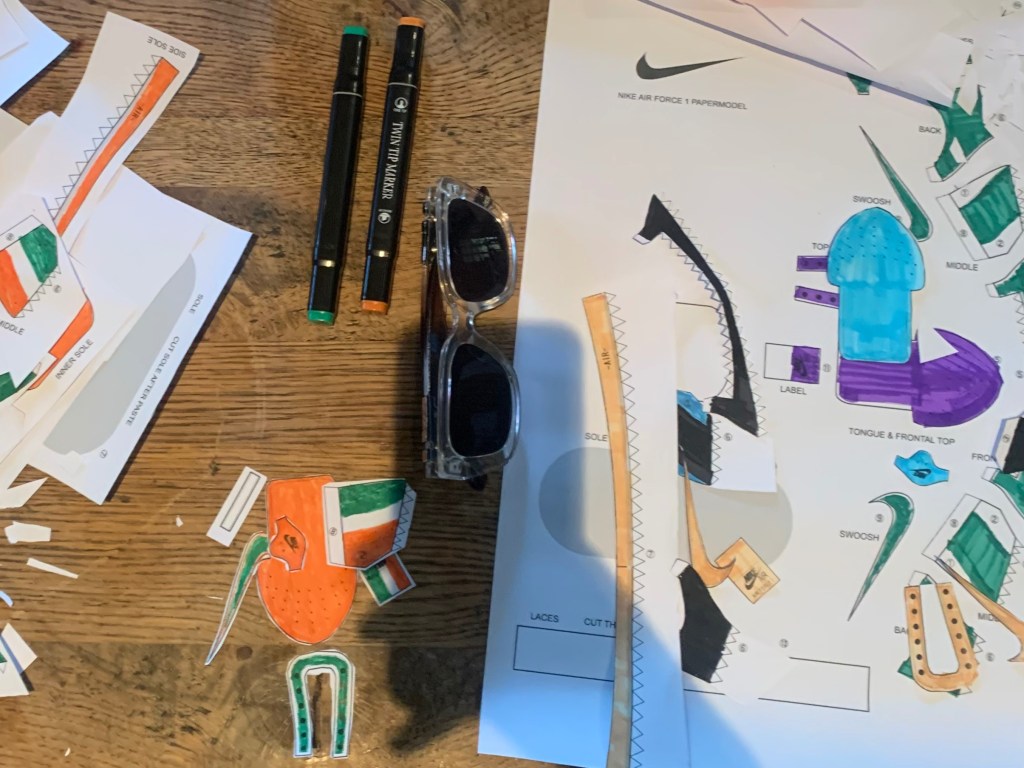
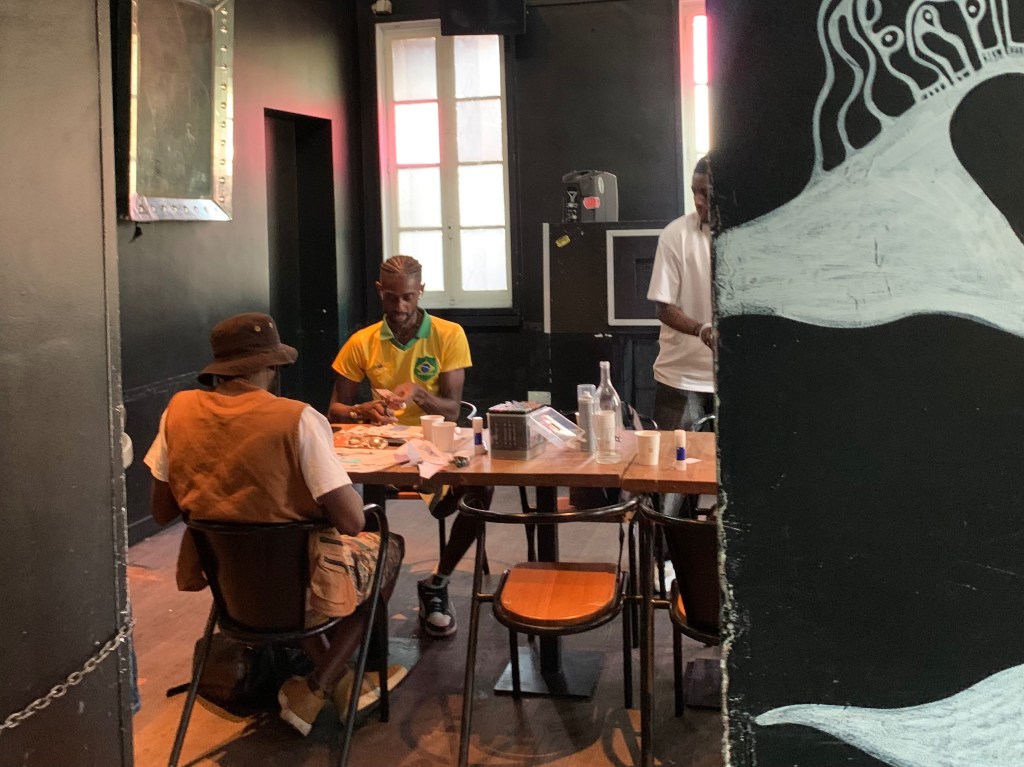
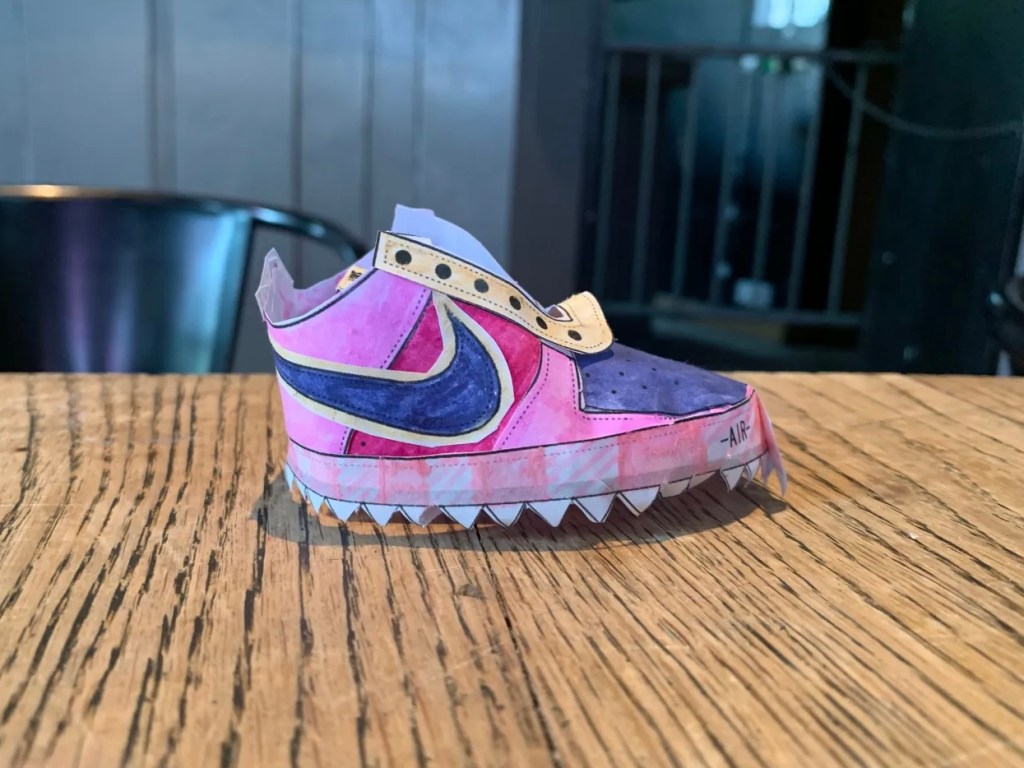
Beyond the technical craft itself, the project resonates deeply with the designer’s personal history. « What I like about Paris Noir is that we belong to this generation with a dual identity. Ever since we were kids, we’ve been told that we’re children of the Republic, but only to a certain extent ». Faced with these layered identities, Yam’s refuses to settle for the status quo. « How do we bring all these stories together ? How do we create this new Paris, or at least this parallel Paris inhabited by the Black communities of the capita l? These are themes that speak to me deeply and that find their way into my work through visual inspirations drawn from Central and West Africa. I try to combine them with elements of my everyday life to create something meaningful for the world ». This search for meaning shapes his relationship with sneakers, which he sees as powerful social signifiers. Using the Nike TN as an example, Yam’s explains how the rest of an outfit can alter the way a pair is perceived depending on the environment. « What you wear on your feet acts as a cultural marker. The sneakers you choose say a lot about who you are ». Yet the growing popularity of these cultural codes also raises broader questions about their appropriation by white elites. « In a way, it was inevitable given our shared history. If you look closely, there is virtually no bourgeois culture that was created by the bourgeoisie itself. Popular culture gets adopted and repackaged, while the people who created it are often pushed aside ». To illustrate this process of cultural absorption, the designer points to the history of jazz, a genre that originally carried the pain and experiences of Black Americans before eventually becoming a marker of social distinction. « That’s simply the nature of those who hold the greatest financial power. The important thing is to learn how to navigate that system, get the most out of it, and understand its codes so we can create something that truly reflects who we are. That’s why I chose to work independently : to collaborate on stories that matter to me. We need to build our own ecosystem and move forward ».
Shining through celebration : eclipse beneath the sun of Bunda Phaat
A few moments later, while another event unfolds in the atrium, the spirit of Bunda Phaat gradually takes over La Rotonde. Like an afterparty that became far more successful than anyone anticipated, the evening quickly exceeds the expectations of its organisers. Just before the festivities begin, Esther Kouakou, a member of Paris Noir, an artist featured in the previous edition, and founder of Bunda Phaat, outlines the philosophy behind the event. Her guiding principle ? Breaking down the elitism of Parisian nightlife. « I’m tired of paid events with RSVP lists, VIP sections, people upstairs and others downstairs, people with wristbands and people without ». A sharply ironic statement, considering that those very wristbands would later become essential to both the smooth running of the night and our reporting. For Esther, parties should remain spaces of experimentation that are both free and accessible. « Paris Noir and Bunda Phaat are places where people can test the projects they dream about. I want aspiring DJs to be able to practise without fear and keep Paris moving ». The name of the party, both provocative and liberating, makes her smile. Having grown up just five minutes from La Rotonde, Esther wanted to inject this historic venue with the raw, communal energy of a block party. It feels like a natural extension of the festival’s mission, providing a platform for emerging collectives and young creatives. Yet beneath the laid-back atmosphere lies a distinctly political and diasporic vision. Esther argues that for many young Black French and African people, music remains one of the most effective ways of carving out space within the capital. At a time when recent legislative proposals threaten the future of free parties, defending free access to celebration becomes, in her eyes, an act of resistance. « Even during difficult times, celebration remains a way of asserting ourselves through collective mobilisation and dance ».
Although the festival presents itself as a reflection of the Black community in all its diversity, its programming reveals a remarkably tight-knit network of personal connections. Childhood friends, relatives, friends of friends, almost everyone seems to know one another in some capacity. This closed-circle dynamic ultimately shapes the sociology of the event itself. Rather than reaching the full spectrum of the Black population of the Paris region, the festival appears to speak primarily to a relatively small, intra-community milieu. To be fair, the promotional material never claimed otherwise : it explicitly presents itself as « the imagination of a generation » : that of a fashionable, culturally connected, distinctly Parisian Black youth. For a project bearing the name Paris Noir so literally, however, this raises important questions. While aspiring to broad representation, the festival only partially engages with the more working-class realities of the capital, exposing a striking geographical contradiction. The neighbourhood surrounding La Rotonde contains one of the highest concentrations of Black residents in Paris. Yet this local population remained largely absent from the atrium throughout the festival. This pursuit of aestheticisation even manifests itself in the visual language of the project. When designer Malé Houinsou repurposes the iconic blue-and-pink checkered pattern associated with Tati, the historic department store that became a symbol of working-class and immigrant Barbès, the gesture is thought-provoking. Here, the motif seems detached from its social history, stripped of its original context before being reintroduced through the codes of contemporary creative branding.
Ironically, it was Bunda Phaat that ultimately succeeded in breaking through these barriers. By moving the party out of the atrium and onto the outdoor forecourt, the event instantly dissolved many of the festival’s invisible boundaries. Freed from its insular atmosphere, the raw energy of the outfits, the dancing, and the music finally achieved what accessibility is meant to look like : drawing in curious passers-by and reconnecting the project with the spontaneity of Parisian street life. As the hours pass, La Rotonde rapidly approaches saturation point. Outside, tensions rise as security staff struggle to manage an increasingly dense crowd. Lacking wristbands, several members of the organising team and invited artists find themselves stranded on the pavement, watching spectators enter only a few at a time. Adding to the confusion, a second party is taking place in an adjacent room, transforming the building’s corridors into a maze of competing energies. It is within the relative calm of the backstage area, far removed from the chaos outside, that we meet Djaksparo. The artist is preparing to perform four tracks, including two unreleased songs. On his wrist sits a Panafrican Hustla bracelet, a choice that is anything but accidental. « It aligns perfectly with my artistic direction because so much of what I do is rooted in Afro influences. I feel deeply connected to the pro-Black dimension of this event. That’s the real reason I’m here tonight ». After seven years in music, having first been introduced to the craft by his older brother, the rapper is enjoying growing success. His track « Pangor » has now surpassed three million streams. With a knowing smile, he offers a glimpse of what comes next. « An album and an EP are definitely coming, but one step at a time. Right now I’m focused on releasing big singles that are going to define the summer ». Leaving the calm of backstage and navigating through the building proves almost impossible given the size of the crowd. By around 11 p.m., inside an atrium bathed in electric-blue light, the audience finally erupts as DJ Malicko becomes the first DJ to take control of the indoor stage. We catch up with him immediately after his set. Downstairs, where the interview takes place, the bass still rattles the walls as he slowly comes down from the adrenaline of the performance. Following in the footsteps of his cousin, DJ Nice, Malicko has been mixing for less than a year. Though he modestly admits that he « could have done better », citing nerves, the delayed arrival of the crowd, and pressure from security staff, audience reactions tell a different story. For him, the significance of Paris Noir extends far beyond nightlife itself. « Paris Noir carries a powerful message. It showcases a generation from the diaspora overflowing with ideas, ambitions, and dreams. It proves that at our age, there are no limits ». His philosophy of nightlife is both physical and political. As the founder of an events company that promotes rest and collective well-being in opposition to the relentless pace of capitalism, this DJ, who has already performed for Jordan and Adidas, finishes with a smile : « I want people to leave my set completely exhausted. They should experience it as something transformative ».
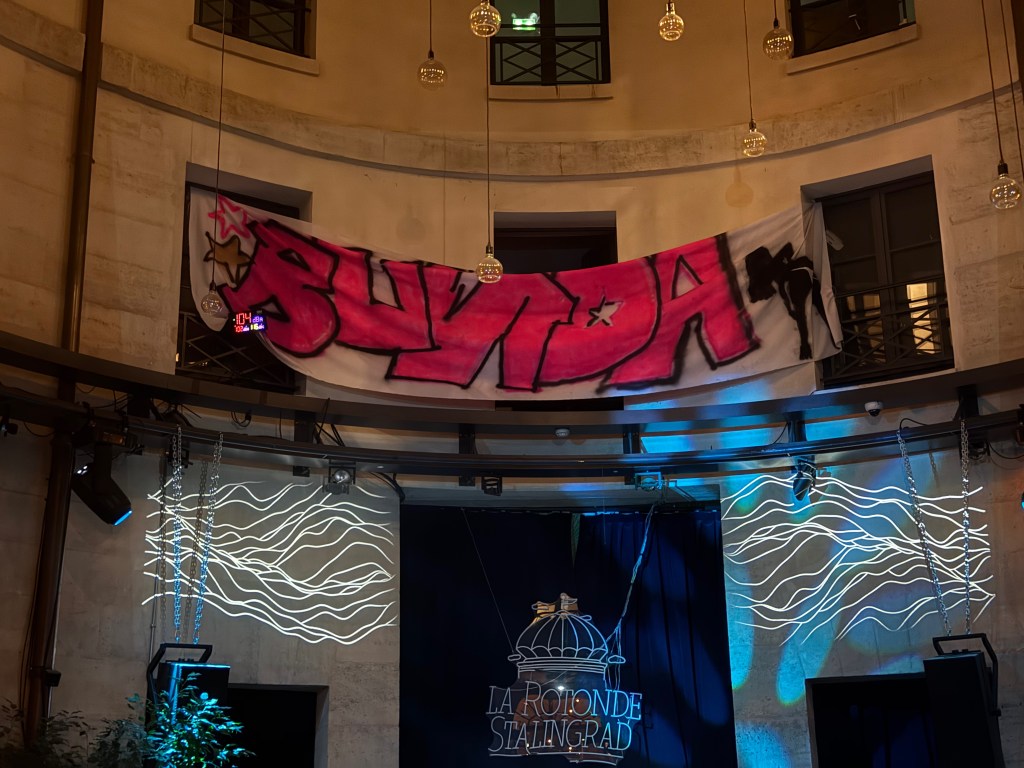
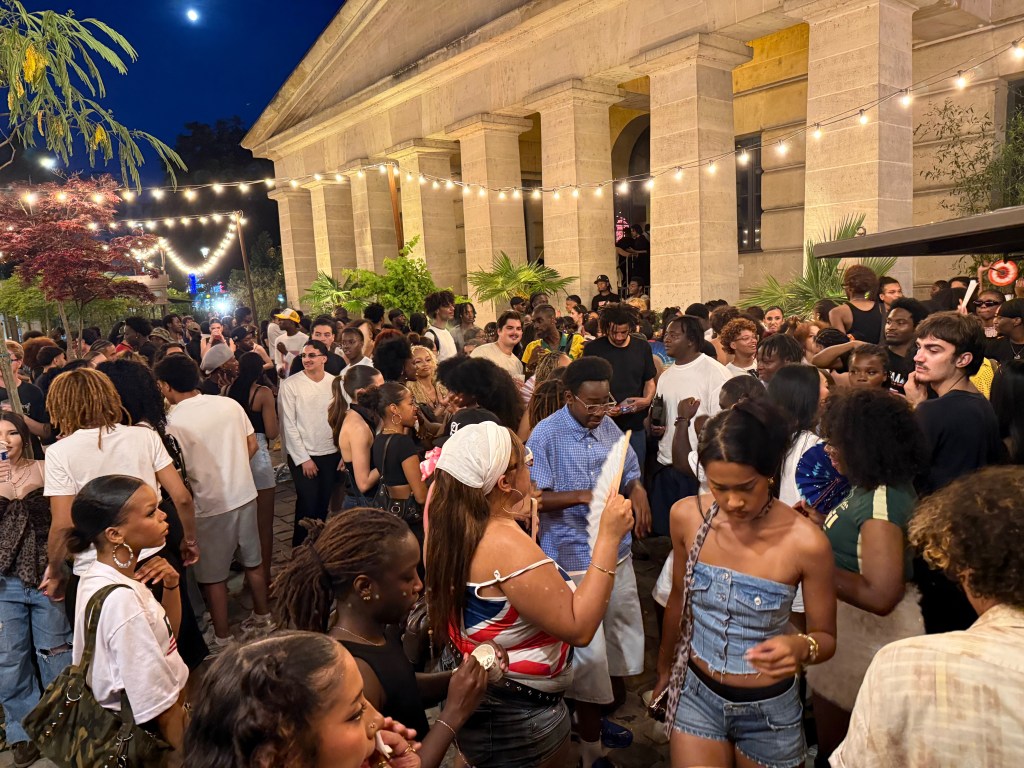
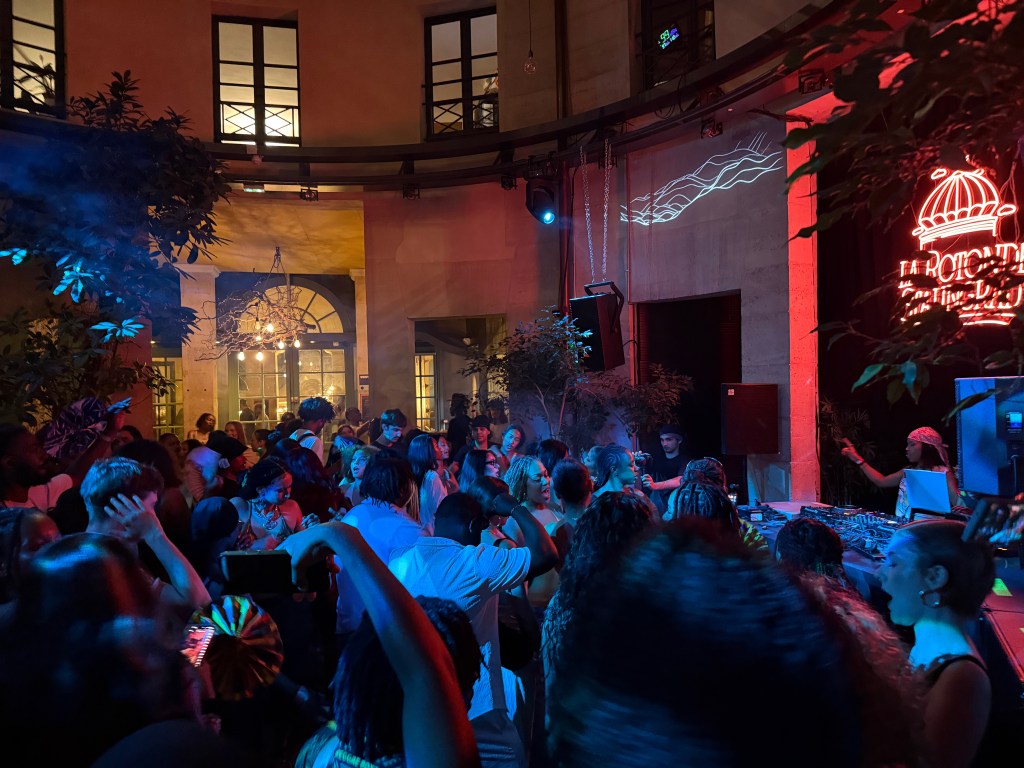
Back in the main hall, the atmosphere has reached its breaking point. The crowd dances relentlessly, fulfilling Esther’s vision, even if the experience occasionally borders on physical endurance. « The outdoor part of the evening was incredible », one young woman tells us from the middle of the crowd. « But once inside, the lack of space becomes impossible to ignore. Free events inevitably attract huge numbers of people, so a much larger venue was needed. Most frustratingly, we got separated from our friends at the entrance. There were seven of us, and only two managed to get in. Thankfully, the atmosphere and the DJ sets make up for it ». To the frustrations caused by overcrowding is quickly added another challenge : the heat. While temperatures outside hover near thirty degrees, the air inside the atrium soon becomes almost unbreathable. There is no ventilation and no access to water. The bar, which Corentin had hoped would generate significant revenue, remains inexplicably closed. Not a single cup or refreshment station is in sight. What follows is a remarkable display of improvisation. Discovering blocks of ice abandoned in a sink behind the deserted bar, clubgoers begin rubbing them on their necks, faces, and shoulders in an attempt to cool down, until a container of water is finally made available. According to Sarah Thernier, Head of Communications for Paris Noir, the logistical chaos can be traced back to a surprising managerial decision by La Rotonde itself. While the venue had initially set the atrium’s capacity at 350 people, management reportedly chose at the last minute to release « more than 200 additional tickets » for an event that had already been sold out for days. The consequences were predictable. Dozens of ticket holders never managed to enter a venue that had become completely overwhelmed. Yet this difficult situation produced a paradox familiar to anyone acquainted with Parisian nightlife. By turning entry itself into a scarce and highly coveted experience, the overwhelming demand ultimately cemented the reputation of both Bunda Phaat and Paris Noir. For one night at least, they established themselves as key architects of the city’s contemporary nightlife culture, where the difficulty of gaining access only intensifies the desire to be part of it.
Final reflections, or the dawn of a new momentum
Beyond the inevitable growing pains of firsts editions, this festival already stands as a historic milestone because of the people behind it : a team whose average age does not even reach twenty-five. For perhaps the first time, such a young generation has successfully claimed cultural space on this scale within Paris, creating a platform of expression, celebration, and visibility by and for the community. Precisely because the project is so meaningful, and so necessary, it deserves to be approached with clarity and critical rigour equal to the ambitions it carries. When asked about the festival’s shortcomings, the founder often framed them through the lens of student resourcefulness, reminding audiences that « we’re students, we have families, we don’t have to do this ». Yet the statement feels somewhat at odds with the reality of the project itself. An initiative of this magnitude is never simply optional. It emerges from necessity : from a desire for recognition, representation, cultural reclamation, and the transmission of collective memory. Likewise, the variety of artistic mediums, the intersections between different diasporas, and the diversity of Afro-French experiences naturally generated a wide range of perspectives and viewpoints. Yet a certain paradox remains visible in the founder’s own admission that, « when it comes to responsibility, I don’t delegate much ». By concentrating leadership so heavily around a single vision, the project risks smoothing over the very plurality of voices that would arguably flourish within a more horizontal structure.
It is here that critic Kevin Beltou’s observation, « being Black is not enough », takes on its full significance. Far from a dismissal, the phrase reads instead as an invitation : an invitation to excellence, but also to perseverance. A challenge worthy of a history that is at once luminous and fractured, central yet too often marginalised, deeply cherished yet continually contested. None of these blind spots, however, should overshadow the festival’s greatest achievement. Paris Noir has succeeded in creating one of those rare spaces of trust where the expression and affirmation of Black identity can finally exist outside the reductive lenses through which it is so often perceived : aggression, provocation, vulgarity, or a supposed form of unruliness. It offers a unique site of convergence where a calm and confident pan-Africanism can emerge, where institutional structures may be critically examined, and where a community can gather, connect, and recognise itself. By linking the personal journeys of guests such as Carmen, guided by memories of her grandmother, Djaksparo, inspired by his older brother, and Malicko, following in his cousin’s footsteps, the project beautifully mirrors the scenography of its own exhibition, which revolved around the imagery of the family living room. Through this embodied form of transmission, the festival lays the foundations for a lasting collective memory within the French cultural landscape. By transforming this inaugural edition into a foundation for the future, Paris Noir gives tangible form to the hopes invested in this generation. In doing so, it encourages us to embrace the closing words of curator Euriell without hesitation : « I want people to leave feeling that the future is in very good hands. They just need to trust us ».
 OUTERNET MAGAZINE
Laisser un commentaire